Securing a reliable workflow automation system is the single best way to scale your operations and reduce manual workload.
You are likely comparing OpenClaw AI and AutoGPT to achieve this goal. Both tools leverage generative ai and large language models to master structured automation, background service management, and autonomous reasoning. These capabilities are the secret to building an efficient digital workforce.
Choosing the right system determines your operational success.
This guide breaks down their differences and reveals how they integrate with platforms like Tencent Cloud Lighthouse or critical business systems such as CRMs and ERPs. We will provide the exact strategies you need to deploy these platforms and gain a massive competitive advantage.
Key Takeaways
- OpenClaw AI offers enterprise-grade workflow automation with reliable, rule-based processing and strong integration across platforms like Tencent Cloud Lighthouse, Salesforce, Stripe, and CRMs. This makes it ideal for large companies needing audit trails, retry logic, and operational safety.
- AutoGPT works as an autonomous agent framework using recursive task decomposition and iterative reasoning. It is well-suited to rapid prototyping and flexible goal-driven tasks in research or startup settings, but it may show variable reliability due to its model-driven nature.
- OpenClaw AI features a modular design that allows non-coders to customise workflows through visual tools and pre-built skills. It maintains governance features like cost dashboards and permission controls, making it more accessible than advanced frameworks such as LangChain.
- AutoGPT relies on prompt engineering for customisation and dynamic tool selection via plugins (including Claude 3.5 Sonnet). Setup is beginner-friendly, but deeper tweaks need coding skills. It is best for isolated experiments or when quick iteration matters most.
- Combining both tools lets organisations use AutoGPT's smart planning (powered by GPT-4 Turbo) for creative breakdowns of complex goals while relying on OpenClaw AI's stable background execution. This creates a strategy for reducing risk in business operations as seen in deployments at Canva or Robinhood.
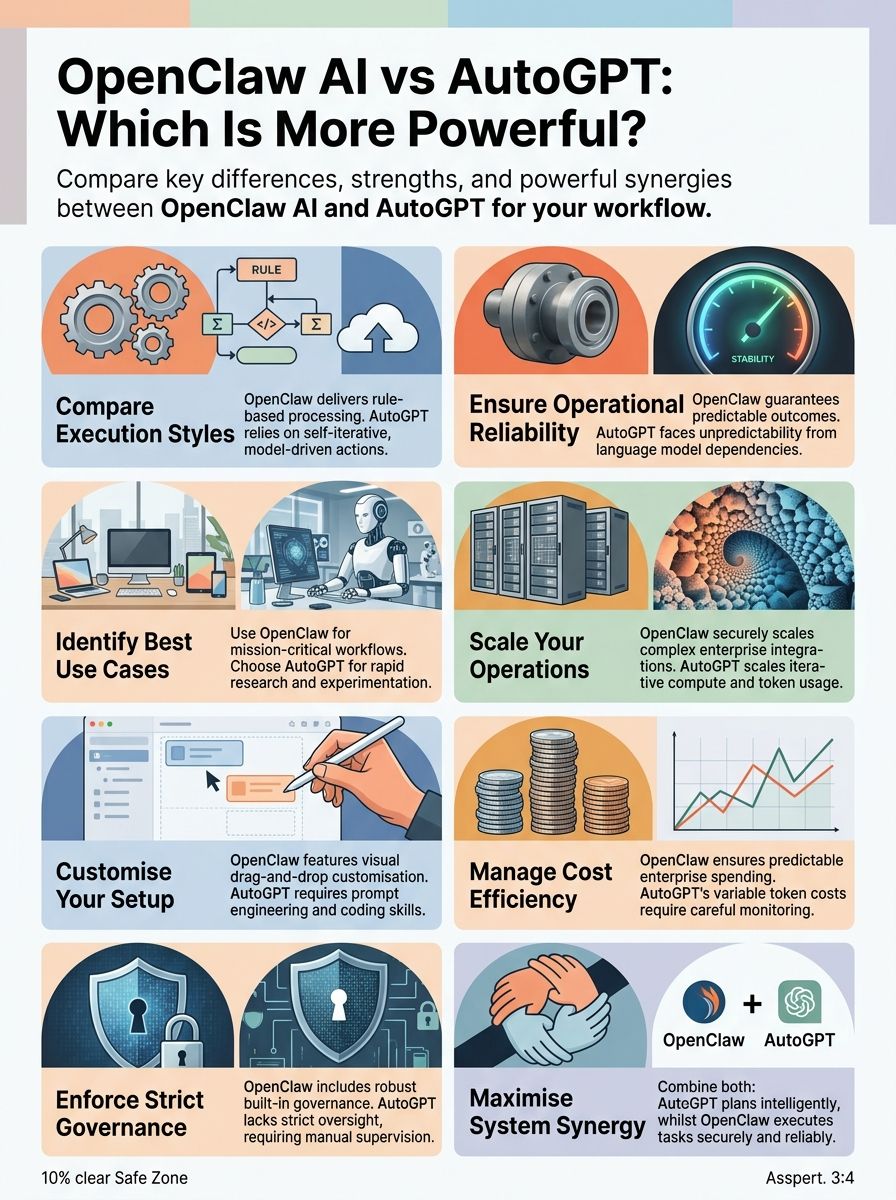
Key differences between OpenClaw AI and AutoGPT
OpenClaw AI acts as a dedicated workflow automation engine for enterprises. AutoGPT functions as a highly flexible autonomous software agent.
Their frameworks apply entirely different methods to process tasks. They both utilise external tools like Vertex AI Workbench and custom API integrations to achieve their goals.
What are the architectural differences between OpenClaw AI and AutoGPT?
OpenClaw AI operates directly in the execution and orchestration layer. It prioritises completing distinct tasks using over 100 preconfigured AgentSkills.
This system links seamlessly with CRMs, ERPs, and tools like ActiveCampaign or Vertex AI Workbench for workflow automation. Its engine manages background service tasks such as monitoring, governance, and integration management.
You will find OpenClaw supports strict enterprise-grade features. These include cost control dashboards, rule-based triggers, reliability checks, and cross-platform automation spanning Salesforce to Stripe.
AutoGPT operates in the autonomous reasoning layer. It relies heavily on machine learning to drive goal interpretation using recursive task decomposition and iterative reasoning loops.
- OpenClaw AI Focus: Built for structured, repeatable processes favoured by major enterprises.
- AutoGPT Focus: Built for rapid, experimental iteration by individual developers like Peter Steinberger or Harrison Chase with their AgenticAI projects.
- Tool Selection: AutoGPT autonomous ai agents break down goals into smaller steps without human prompts. They then select tools dynamically from APIs like BigQuery ML or Dataproc Spark.
- Intelligence Separation: The AutoGPT system isolates intelligence from the direct execution infrastructure. This keeps decision-making agile but contained within an isolated environment.
This separation is essential when building advanced artificial intelligence models. These support deep agents used by major enterprises including Canva or Robinhood.
How do the core functionalities of OpenClaw AI and AutoGPT compare?
OpenClaw AI delivers a highly structured platform for building versatile ai agents. It specialises entirely in strict workflow automation across enterprise systems like Microsoft Teams or Tencent Cloud Lighthouse.
Its modular structure supports deep customisation and context engineering. This helps developers shape personal ai assistants to fit exacting corporate workflows. GitHub stars reflect strong community backing, and this open-source approach appeals to organisations needing precise control.
Users gain total operational control. Advanced options in integration and scaling are available through core tools such as the model context protocol and developer framework.
OpenClaw AI connects directly to messaging apps like Slack, WhatsApp, and iMessage. This allows it to act as a high-privilege user rather than a limited chatbot.
AutoGPT simplifies autonomous agent tasks by using a self-iterative process. It makes rapid decisions without manual input steps.
Its beginner-friendly interface suits quick task execution and proactive ai agent deployment in saas environments. Users often add autogpt plugins for extra functionality.
AutoGPT requires minimal technical skill compared to OpenClaw AI. It is ideal for users seeking efficient artificialintelligence solutions straight out of the box. AutoGPT remains popular among those looking for swift background service implementation rather than deep customisation.
What distinguishes workflow automation from autonomous agents?
Workflow automation tools execute a strict series of predefined steps. Platforms like OpenClaw AI, n8n, and Assembled allow non-developers to build these sequences using visual interfaces and natural language processing.
These tasks follow absolute rules to handle background services or SaaS tasks. This predictability guarantees the reliability and performance required for enterprise needs.
- Workflow Automation: Relies on the CDP protocol to maintain precise control over browser actions and data entry.
- Market Shift: In February 2026, OpenAI acquired OpenClaw to focus heavily on corporate automation. This signals a massive industry shift from conversational AI to strict task executors.
- Autonomous Agents: Tools built with AutoGPT or Vertex AI Agent Builder act with broad freedom. They analyse goals and iterate on solutions without constant user input.
This flexible approach mimics a self-hosted AI agent framework found on GitHub. It can manage advanced tasks but may lack the production-level stability seen in workflow automation tools from Forethought or StackAI.
Autonomous agents excel in research settings. They often demand deep technical skill for safe deployment at a massive scale.
How does OpenClaw AI differ from traditional tools?
OpenClaw AI delivers enterprise-grade, rule-based workflow automation that adapts to environmental changes. It stands out because it guarantees deterministic execution.
This means every process follows clear rules and yields predictable results. Traditional RPA tools break instantly when a website updates its layout or a popup appears.
VentureBeat dubbed 2026 the “OpenClaw moment” exactly because this tool uses dynamic reasoning to overcome simple UI changes. Traditional tools often lack this level of operational reliability and control.
This older software causes inconsistent behaviour across platforms like CRMs or ERPs. OpenClaw provides built-in features for monitoring, audit trails, and retry logic.
OpenClaw AI acts as a true automation infrastructure layer rather than just an experimental script. Multi-platform support allows rapid deployment into environments such as Tencent Cloud Lighthouse or C# systems.
The integration ecosystem is engineered for scalability and strict governance. Many competing SaaS tools still miss these essential safeguards.
Strengths of OpenClaw AI
OpenClaw AI brings enterprise-grade workflow automation directly to your operating system. It blends seamlessly with Sendbird, Robin by Atera, and functions smoothly as a background service on Tencent Cloud Lighthouse.

What enterprise-grade workflow automation features does OpenClaw AI offer?
OpenClaw AI combines strict workflow automation, strong governance, and high operational safety for critical business tasks. The platform connects CRMs, ERPs, and services like Sendbird using secure API integrations.
A proactive “Heartbeat” monitoring feature is a massive advantage. This allows the system to independently browse the web, check systems, and alert you to issues before they escalate.
- Audit Trails: The system logs every single step for total transparency.
- Auto-Retries: Failed processes trigger immediate auto-retries. This keeps operations running even if an API error pops up.
- Predictability: Workflows remain completely predictable because triggers and steps repeat exactly each time.
- Enterprise Cost: For major US corporations, full OpenClaw enterprise deployments range from $10,000 to $50,000. This covers custom AI logic and infrastructure controls.
Teams easily automate revenue operations or complex cross-system jobs at scale using this enterprise AI agent framework. The platform tracks activity closely to ensure compliance in data-sensitive fields like finance or healthcare.
Each background service runs with built-in monitoring. This helps teams spot issues fast before they spread to other systems such as Soraban or lm-kit.net tools. These features make OpenClaw self-hosted AI perfectly suited for scaling automated processes on platforms such as Tencent Cloud Lighthouse or through GitHub Stars deployments.
How scalable and reliable is OpenClaw AI?
Structured execution enables OpenClaw AI to manage complex workflow automation across massive enterprise environments with perfect accuracy. Its core architecture prioritises predictability.
Businesses using CRMs, ERPs, or SaaS tools demand reliable results every time a process runs. OpenClaw recently achieved an impressive 56.4% accuracy rate on the SWE-Bench Pro test. This proves its massive capability for handling advanced logic without failing.
The system prevents common memory loss issues by using native compaction. This allows the AI to maintain a constant state during long operations.
The platform supports automatic retries and timeouts for failed steps. This helps it manage background service interruptions that frequently occur in real-world operations.
Scalability stems from its power to connect with multiple operational systems simultaneously. It is highly suitable for production-ready tasks where thousands of jobs run side by side.
Companies moving away from experimental ai agent frameworks to deterministic tools gain consistent performance and a lower risk of errors. Regular validation of baseline operations before adding new channels keeps things stable during rapid growth.
How well does OpenClaw AI integrate with existing systems?
OpenClaw AI connects instantly with many platforms, thanks to its one-click deployment and modular skill installation features. Users regularly launch OpenClaw through the AI AGENTS application template on Tencent Cloud Lighthouse.
This streamlined setup keeps the entire environment secure and isolated from local hardware.
- Cost-Effective Hosting: Deploying a US-based Silicon Valley node on Tencent Cloud Lighthouse costs about $3 a month for a 2C4G server.
- Continuous Uptime: This specific cloud setup guarantees 24/7 seamless real-time monitoring.
- Safe Testing: Best practices dictate that users must test connections by sending messages, rotating API keys, and taking environment snapshots before pushing updates.
You must avoid exposing admin surfaces online or installing unreviewed skills. These are common pitfalls seen in amateur real-world deployments.
Treating external systems as unreliable is the best way to prevent issues before they affect your business operations or self-hosted AI agent framework setups.
Strengths of AutoGPT
AutoGPT operates as a brilliant intelligent agent framework. It runs background services that process tasks with virtually zero human input.
Its deep plugin support and compatibility with models like Claude 3.5 Sonnet make it incredibly popular on platforms like GitHub. Developers rely on it for the rapid development of deployable applications.

How does AutoGPT execute autonomous tasks?
AutoGPT functions as an open-source ai agent framework that identifies a goal and asks, “What should I do next?” It relies on recursive task decomposition to break massive goals into tiny subtasks.
This Python application chains consecutive LLM calls to plan and reflect on its progress. The system runs in background services like Tencent Cloud Lighthouse or custom self-hosted setups.
Agents select tools dynamically. They use iterative reasoning loops to advance from one step to the next without waiting for human permission.
Agents utilise dynamic tool selection. They choose the exact plugins or features most suited for each subtask, pulling autogpt plugins instantly when needed.
This process enables constant self-evaluation. If an agent makes a mistake or requires more data, it adjusts its plan and tries again until the job is done.
Execution relies heavily on factors such as prompts, the chosen AI model, runtimes, and strict resource limits set by developers such as Philip Ruffini or Peter Steinberger. Users easily experiment with multi-step reasoning tasks and run research prototypes for workflow automation in areas from rag systems to deployable applications.
How adaptable is AutoGPT across different use cases?
AutoGPT supports rapid iteration and adjusts flawlessly to tasks demanding recursive multi-step reasoning. Developers heavily favour the framework for prototyping autonomous agents in early-stage autonomy.
Adjusting prompt design and runtime constraints lets users manipulate the execution behaviour. This makes it perfect for testing AI-native tools or isolated workflows.
- Web-Native Tasks: It excels at dynamic web browsing and data collection where brittle, traditional scripts fail.
- Startup Innovation: In late 2025, startups like TinyFish raised $47 million based on web-native agent concepts inspired by these exact frameworks.
- Goal-Driven Projects: Startups choose AutoGPT for its unmatched speed in testing out new ideas.
The tool fits scenarios where flexibility is key, such as iterative problem-solving or workflow automation on Tencent Cloud Lighthouse. Its adaptability shines during exploration but remains limited in production due to known reliability issues.
Peter Steinberger and many GitHub contributors choose it mainly for low-risk experimentation rather than mission-critical deployments. It is a favourite among developers eager to test autogpt plugins without heavy setup constraints.
How easy is it to set up AutoGPT?
Setting up AutoGPT is surprisingly quick for most beginners. It features a user-friendly interface and simple installation steps.
You can run it locally or leverage cloud environments like Tencent Cloud Lighthouse. This offers excellent flexibility for both small projects and rapid test runs.
Setup requires cloning the main GitHub repository and inserting your specific OpenAI or Anthropic API keys into the configuration file.
Basic setup avoids complex configuration. You follow a few prompts, and the ai agent framework handles the heavy lifting.
For deeper customisation, technical skills are highly beneficial. Working with Github Stars or tweaking background service settings requires some Python knowledge.
While community support is massive in 2026, OpenClaw AI still maintains a larger help base if you need highly detailed guidance. AutoGPT's less-structured setup suits fast deployment rather than strict enterprise workflow automation tools.
Direct comparison: OpenClaw AI vs AutoGPT
OpenClaw AI and AutoGPT deploy vastly different strategies. OpenClaw relies on workflow automation on Tencent Cloud Lighthouse, while AutoGPT offers flexible ai agents for broad tasks.
Each platform brings distinct advantages in performance and personalisation. Understanding these differences guarantees you make the right choice.
Which offers better performance and efficiency?
Performance and efficiency depend entirely on the specific task. OpenClaw dominates structured tasks, while AutoGPT wins in creative problem-solving.
Here is a detailed summary of how OpenClaw AI and AutoGPT measure up in these crucial areas:
| Aspect | OpenClaw AI | AutoGPT |
|---|---|---|
| Execution Style | Deterministic, rule-guided processing | Self-iterative, model-driven actions |
| Reliability | High, with predictable outcomes and reliable failure management | Less predictable due to Large Language Model dependencies |
| Workflow Automation | Ideal for enterprise-grade, production-ready environments | Suited for quick, experimental or isolated workload automation |
| Scalability | Handles large volumes and complex workflow integrations across platforms | Excels at token and compute scaling for iterative tasks |
| Consistency | Ensures repeatable results in mission-critical use cases | Prone to variation across runs, especially in research settings |
| Speed | Rapid for structured workflows, minimal re-execution required | Faster in self-improving tasks where repetition is beneficial |
| Integration | Strong compatibility with existing enterprise software and platforms | More limited, with primary focus on internal task loops |
| Best Use Case | Mission-critical operations, high-volume business processes | Research, experimentation, isolated or one-off tasks |
How do customisation capabilities compare?
Customisation options in OpenClaw AI and AutoGPT vary significantly. They reflect their unique strengths and entirely different target users.
OpenClaw allows rapid updates through pre-built AgentSkills, while AutoGPT requires Python script adjustments. The table below outlines their key differences.
| Aspect | OpenClaw AI | AutoGPT |
|---|---|---|
| Customisation Model | Modular design with skill and integration modules, enabling drag-and-drop workflow customisation | Relies on prompt engineering and dynamic tool selection to adjust agent behaviour and task flow |
| User Accessibility | Non-coders can customise workflows using the visual setup and pre-built skill ecosystem | Developers must code for advanced features; more technical expertise required for major tweaks |
| Workflow Control | Offers guided, structured workflow automation, ideal for operational setups across industries | Excels in designing flexible, recursive tasks, suitable for research experiments and prototyping |
| Extension Method | Skills and integration modules added with little or no code, promoting rapid deployment | Features extended via Python scripts, direct code, or prompt modifications |
| Governance | Features built-in governance and permission controls for operational use | Lacks built-in governance, leading to fewer restrictions and oversight |
| Integration Ecosystem | Multi-platform integration across CRMs, ERPs, messaging apps, and email systems | Supports third-party APIs, but integration paths are less structured |
| Best Suited For | Enterprises seeking rapid, user-driven solutions with visual configuration | Researchers and developers exploring new agent strategies and custom task setups |
| Notable Limitation | Less customisable than frameworks like LangChain but more accessible for business teams | Limited workflow oversight, and advanced features demand programming skills |
Which is more cost-effective?
Cost efficiency plays a massive role in both enterprise and experimentation settings. OpenClaw provides predictable hosting costs, whereas AutoGPT carries the risk of runaway token expenses.
A basic OpenClaw VPS implementation in the US costs between $10 and $30 monthly. AutoGPT costs spike rapidly if recursive loops are left unmonitored.
| Aspect | OpenClaw AI | AutoGPT |
|---|---|---|
| Cost Control | – Predictable spending using deterministic workflows – Minimises token usage by summarising and limiting dialogue – Supports snapshotting, reducing expense from downtime – Budgeting is straightforward in production | – Variable cost based on compute and token use – May spike in production if left unchecked – Lacks built-in summarisation or workflow limits – Monitoring is needed to avoid runaway charges |
| Best Use Case | – Mission-critical operations – Ongoing, large-scale, or repetitive tasks – Enterprise-grade reliability needs | – Rapid experimentation – Short-lived or prototype tasks – Development and research contexts |
| Operational Reliability | – Reduces failure-related costs – Supports rollback, lowering business risk – Scalable without surprise surges | – Unpredictable outcomes can increase hidden costs – Lack of guardrails may lead to system errors – Works best with manual supervision |
| Integration Impact | – Integrates smoothly with existing platforms – Limits costly disruptions during upgrades | – Standalone agent – May require extra resources for complex integration |
| Summary | – Consistent and cost-efficient in scaled deployments – Favoured for long-term automation in industries like banking or logistics | – More affordable for quick trials – Suited for startups or research teams testing new ideas |
When should I choose OpenClaw AI?
OpenClaw AI is the perfect fit for companies demanding reliable workflow automation across essential systems like CRMs and ERPs. Choose it if you require clear audit trails, retry processes, and total data sovereignty.
Operational reliability remains its greatest strength. OpenClaw manages complex tasks safely, logs every failure, and rolls back changes without breaking the system.
- Local Control: It runs seamlessly as a background service on private servers or Tencent Cloud Lighthouse.
- Production Readiness: Enterprises moving from simple experiments to structured automation benefit massively.
- Security: It provides the strict governance needed to protect sensitive corporate data.
If scaling securely matters more than creative task handling, OpenClaw delivers the control needed for your organisation's ai agent framework and workflow orchestration requirements.
When is AutoGPT the better choice?
AutoGPT is the superior choice for projects requiring flexible, goal-driven AI agents. It thrives in research settings where recursive, multi-step reasoning is the primary requirement.
Many US startups leverage AutoGPT to aggressively experiment with workflows before locking them into a full-scale workflow automation tool.
Developers prefer AutoGPT for early-stage prototyping and rapid iteration. It supports continuous AI experimentation without restrictive corporate guardrails.
Its core strength is pure adaptability. This makes it a strong fit where autonomy matters more than strict operational control or financial predictability.
Production environments demanding stable background services will struggle with AutoGPT. If innovation, speed, and isolated testing are your priorities, AutoGPT remains a highly capable option.
Can OpenClaw AI and AutoGPT be used together?
OpenClaw AI and AutoGPT function beautifully as a combined team. Each system handles a completely different stage of the workflow automation cycle.
AutoGPT, powered by GPT-4 Turbo, acts as the primary brain. It makes smart decisions and breaks massive goals into smaller tasks using autonomous reasoning.
- The Planning Phase: AutoGPT analyses the goal and outputs a structured JSON plan.
- The Execution Phase: OpenClaw AI ingests this plan and uses its AgentSkills to deliver reliable execution across platforms like Tencent Cloud Lighthouse.
- The Scaling Phase: Startups run trials with AutoGPT first, then add OpenClaw's strict task management for secure scaling.
This combination builds a highly secure layered setup. AutoGPT operates as the intelligent planner, while OpenClaw enforces strict workflows to keep execution safe.
Organisations achieve much safer operations this way. The severe risks linked to unsupervised ai agents drop sharply because each finished job gets tracked within established rules. This pairing supports enterprise-grade infrastructure that balances creativity with strict governance at every step.
Conclusion
Choosing between workflow automation tools like OpenClaw AI and smart agents such as AutoGPT depends entirely on your exact goals. OpenClaw stands out for tight control, reliable background tasks, and smooth integration with CRMs or ERPs.
AutoGPT remains impressive for teams needing flexible reasoning or goal-based decision-making. It easily adapts and thinks through complex steps where rigid tools fail.
You unlock massive power by combining these strengths. Using AutoGPT's intelligence alongside the stable execution of OpenClaw means you achieve both rapid speed and precision at scale.
Find the perfect mix for your team, and let each technology play to its massive advantage.
For a deeper understanding of how OpenClaw AI stands apart from conventional automation solutions, read our detailed analysis on the key differences between OpenClaw AI and traditional tools.
FAQs
1. What are the main differences between OpenClaw AI and AutoGPT?
OpenClaw AI is a local-first runtime built on Node.js that executes tasks directly through messaging apps like WhatsApp, whereas AutoGPT is a Python platform designed for research and complex text generation. The primary difference is that OpenClaw provides each agent with an isolated workspace to prevent context contamination during dynamic workflows. AutoGPT currently boasts over 170,000 GitHub stars and remains the preferred choice for natural language processing tasks.
2. Which system delivers more powerful results for business applications?
For US businesses needing flexible automation, OpenClaw AI delivers superior operational results because it offers over 3,000 community-built skill extensions on ClawHub to control local applications directly. Conversely, AutoGPT provides better performance for teams focused on producing high-quality written content through its low-code Agent Builder interface.
3. How do OpenClaw AI and AutoGPT handle real-time data analysis?
OpenClaw AI processes real-time information continuously by running as a persistent background process on your local hardware or virtual private server, whereas AutoGPT interprets live data only within active, temporary chat sessions.
4. Is one platform easier to implement than the other for new users?
AutoGPT is generally simpler for new users to implement because it provides a guided web interface for straightforward prompt-based setup. In contrast, OpenClaw requires users to run a command-line installer script via npm and configure application programming interfaces manually. While OpenClaw demands more initial technical expertise, it rewards users with a completely isolated and customisable environment once installed.
References
- https://www.hireoverseas.com/blogs/openclaw-vs-autogpt
- https://www.tencentcloud.com/techpedia/141602
- https://stormap.ai/post/openclaw-vs-autogpt-which-ai-agent-framework-is-right-for-you (2026-02-16)
- https://www.tencentcloud.com/techpedia/141238
- https://www.researchgate.net/publication/373002717_What_if_GPT4_Became_Autonomous_The_Auto-GPT_Project_and_Use_Cases (2023-08-13)