Automating your daily tasks should save you time, not create a new headache.
Many people struggle to find the right tools for task automation and file management. They often feel stuck with slow or rigid options.
OpenClaw is an AI agent platform that has quickly become popular by letting users automate workflows directly on their computers using natural language.
This guide breaks down how OpenClaw compares with traditional solutions like chatbots, large language models, and classic workflow automation software. We will help you understand which option fits your specific needs.
You are about to discover the secret to smarter digital work.
Key Takeaways
- OpenClaw uses agentic AI and large language models (LLMs) to automate workflows with natural language, unlike traditional RPA tools that follow strict scripts and break easily if rules or inputs change.
- Traditional automation suits regulated US sectors such as banking and healthcare, where fixed flows, audit trails, and strict HIPAA compliance are essential. Typical enterprise RPA deployments in the US cost between $10,000 and $50,000 per year.
- OpenClaw adapts independently to unstructured data from emails or chats across platforms like WhatsApp and Telegram. It offers access to over 400 LLMs via APIYI at around 90% lower prices than official rates.
- Combining OpenClaw with classic file management or RPA tools can automate up to 60% more business processes while reducing errors through feedback learning. Hybrid solutions increase both coverage and efficiency.
- As of February 2026, OpenClaw has over 100 prebuilt skills and leads open-source adoption in workflow automation with more than 200,000 GitHub stars. Experts such as Peter Steinberger support this trend for autonomous digital workers using modular Node.js frameworks.
What are the key differences between OpenClaw and traditional tools?
OpenClaw changes the game by using agentic AI and large language models (LLMs) for flexible task automation. Classic tools rely heavily on rigid, rule-based scripts.
Digital workers powered by OpenClaw can handle complex file management or browser control in ways old solutions cannot match. A 2026 report from Acuvate highlights that agentic AI systems can reduce process cycle times by up to 50% through autonomous exception handling.
How does decision-making differ between scripted and reasoned approaches?
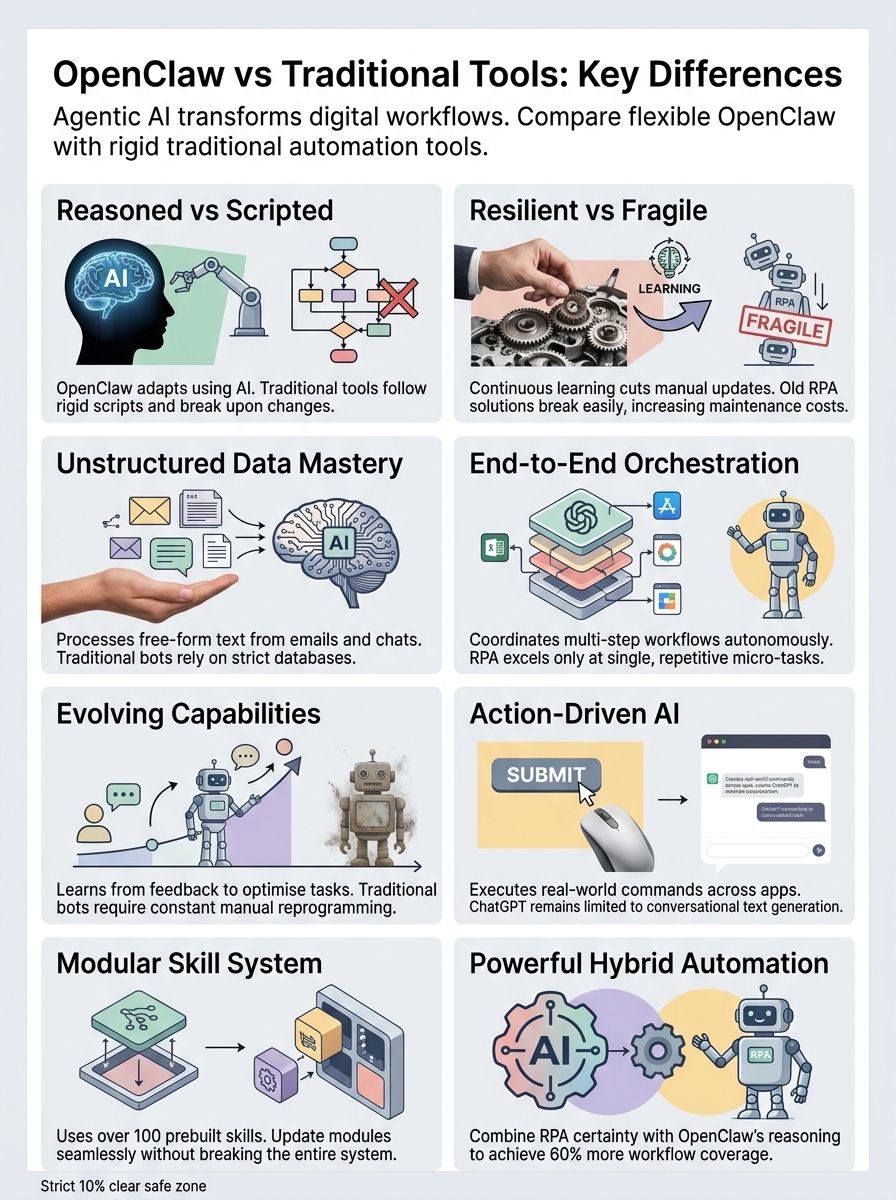
Traditional automation tools like RPA run on scripts and follow fixed rules. Actions happen step-by-step, exactly as written in the code.
If a task changes or an input is new, these systems often break or require manual edits. For example, a digital worker using traditional scripts might process emails but cannot spot urgent issues unless told ahead of time.
Agentic AI platforms such as OpenClaw use large language models and goal-driven reasoning instead. They rely on a cognitive reasoning engine to interpret intent from unstructured data and make choices based on context.
If you say, “Clean my inbox, summarise important emails, schedule meetings,” OpenClaw acts across several applications without new instructions each time.
The system can personalise replies to customer complaints or escalate problems when needed by accessing over 400 AI models, including Claude and GPT via APIYI. Autonomous decision-making lets it adapt quickly, while older scripted tools remain rigid unless someone rewrites their logic.
Why are some systems fragile while others are resilient?
RPA tools often break down because they rely on fixed flows. A small change in a target system or browser control can disrupt the entire process, making these enterprise RPA solutions very brittle.
Industry experts from Anaptyss noted in 2026 that a simple missing field on an invoice can stop a traditional bot completely. About 30 to 40% of maintenance costs come from having to fix things after such breakdowns. File management and workflow orchestration become expensive headaches due to this fragility.
OpenClaw works differently. It uses large language models for autonomous decision-making and shows agentic AI behaviour. This lets it adapt to new challenges on its own.
Instead of following strict scripts, OpenClaw's AI agents reason through tasks using both structured and unstructured data sources across messaging platforms like WhatsApp or Telegram integrations.
User feedback reveals that OpenClaw suggests optimisations in real time. This continuous learning cuts manual updates, bringing down operational costs for AI operations teams by reducing system-level automation issues.
A resilient system does not just survive change; it learns from every challenge it faces.
How do structured and unstructured data affect input processing?
Traditional tools like RPA work best with structured data, which uses fixed formats in tables or databases. These systems handle clear columns and rows easily but often fail when faced with free-form information.
Nearly 90% of business data is unstructured today. This includes formats such as:
- Customer emails and free-text support tickets.
- Complex PDF invoices and scanned receipts.
- Informal chat logs from WhatsApp and Telegram.
- Real-time sensor data and web scraping outputs.
This reality shows how limited traditional automation can be for file management involving real-world inputs.
OpenClaw processes both structured entries and unstructured sources seamlessly through large language models and agentic AI. It understands natural language requests on messaging platforms easily.
OpenClaw extracts meaning from mixed files or web pages, stores insights in databases or data lakes, and then notifies users once a task ends. This flexible approach supports digital workers dealing with changing requirements across content creator workflows and browser control tasks on GitHub stars projects without needing constant updates to the codebase.
What distinguishes micro-tasks from end-to-end automation?
RPA tools focus heavily on micro-tasks. They excel at single, repeated steps like copying data from one file to another or filling forms in browser control settings.
These digital workers execute clear instructions, but they cannot manage complete workflows alone. Manual effort is often needed to link different tasks together.
Industry experts like R Dilip Kumar point out that this method struggles with anything more complex without substantial integration work.
OpenClaw's agentic AI handles end-to-end process orchestration instead, shifting from task-based execution to outcome-driven automation. This allows it to coordinate multi-step workflows alone.
For example, it can manage expense reimbursements across messaging platforms like WhatsApp or Telegram, update databases, fetch information from multiple sources, and send notifications within a single workflow.
Its skills system connects seamlessly with productivity apps, file management systems, node.js automation platforms, and large language models (LLMs). OpenClaw bridges the full journey of a task from planning through action.
How do static and evolving capabilities impact learning ability?
Traditional automation tools, like RPA, work in a fixed way. Developers must reprogram these digital workers for any update or new task.
They do not learn from mistakes or user feedback and cannot adapt to changing workflow needs without manual changes. This limits their ability to grow smarter over time.
OpenClaw, built on agentic AI infrastructure with large language models (LLMs), shows evolving capabilities. It features memory and knowledge systems that retain historical context across sessions.
An evolving AI agent turns everyday conversations and manual corrections into powerful training signals for future tasks.
It learns through session memory, skill acquisition, and feedback optimisation every time it runs a process.
After observing new file management patterns or updates in browser control tasks, OpenClaw refines its approach automatically. Users like Philip Ruffini or Krunal Chaudhari notice improved efficiency fast.
These autonomous AI agents suggest better workflows based on pattern recognition and lower operational costs as they get smarter at every step.
How does OpenClaw compare to other AI solutions?
OpenClaw takes agentic AI beyond simple chat tools by acting as a self-hosted, autonomous digital worker on your machine.
It connects large language models and browser control to handle complex tasks across platforms like WhatsApp or Telegram.

What are the differences between OpenClaw and ChatGPT?
ChatGPT has become a household name for text generation and recently introduced a cloud-based Agent mode. However, OpenClaw changes the game by turning conversations into real-world actions directly on your local device.
A 2026 review from Get AI Perks notes that while ChatGPT Agent operates in a restricted cloud sandbox and limits users to 40 tasks per month on its $20 Plus plan, OpenClaw offers unlimited, full local file system access for free. The table below highlights their major differences.
| Feature | OpenClaw | ChatGPT |
|---|---|---|
| Primary Function | Executes commands, runs workflows, and performs multi-step reasoning | Generates text, answers questions, and provides suggestions |
| Action Orientation | Action-driven, interfaces with computer systems and applications natively | Text-driven, limited to conversational responses and cloud sandboxes |
| Integration With Platforms | Works with WhatsApp, Telegram, Slack, Discord, and more | Accessible on OpenAI's site and some select apps |
| Skill System | Includes 100+ prebuilt skills, supports scripts and custom extensions | Does not support custom local skill integrations |
| System Type | Bridges language models to user systems for local desktop automation | Standalone conversational cloud agent |
| Multi-Agent Workflows | Supports collaborative agents for complex tasks, especially via Moltbook | No multi-agent collaboration available |
| Real-World Actions | Can access local files, trigger desktop apps, manage user workflows | Cannot perform or initiate real-world local digital actions |
| Customisation | Open to developer extensions and custom automations on Node.js | Limited customisation via user prompts |
| Productivity Connections | Connects natively with browsers, productivity apps, and messaging platforms | No direct local connection to productivity tools |
Technical architecture: OpenClaw vs traditional tools
Explore how OpenClaw's modular structure with AI agents, large language models, and workflow automation sets it apart from node.js-based conventional software. We will discover why this difference matters for your business.

What is modular design in OpenClaw?
Modular design in OpenClaw lets developers use “skills” as building blocks for a highly customisable system.
Each skill connects directly to platforms like WhatsApp, Slack, Discord, file systems, or browsers. More than 100 prebuilt skills exist today.
Developers can create their own custom scripts if they want extra features for task automation or workflow automation. A 2026 architectural breakdown by ByteMonk revealed that OpenClaw uses a unique Gateway Layer for message orchestration and a memory system based on write-ahead logging.
It saves your agent's context into local Markdown files to prevent data loss. These modules work together so digital workers and large language models (LLMs) can complete tasks and coordinate with each other seamlessly.
You can update any skill at any time without affecting the rest of your system. This helps teams move fast and stay secure.
The Moltbook platform supports agent collaboration for research projects and advanced experiments with artificial intelligence agents. Node.js powers these core processes, making integrations simple across messaging platforms and productivity tools such as GitHub Stars or CI/CD pipelines.
This modular setup gives developers full control over data privacy and quick access to new capabilities in areas like browser control or scientific workflows led by experts like Peter Steinberger.
Why do traditional tools have limited flexibility?
Traditional RPA tools like UiPath or Automation Anywhere use rigid rule engines and screen recorders. These systems depend on strict rules, so even small changes in a website or file management process can stop an automation from working entirely.
Developers must then step in to fix the problem by hand. This manual work drives up maintenance costs, with 30 to 40% of enterprise RPA budgets covering these fixes alone.
Many traditional solutions stick to low-code drag-and-drop interfaces instead of using natural language or agentic AI models like large language models (LLMs). This approach limits customisation due to several factors:
- Traditional bots scale linearly, requiring a brand new bot for every minor new task (Acuvate 2026).
- Proprietary licensing restricts developers from changing the core codebase.
- Rule-based systems cannot parse unstructured data from WhatsApp or Telegram effectively.
Native AI integration is rare and usually optional, meaning flexibility barely improves over time compared to evolving agent frameworks inspired by people like Peter Steinberger, who champion more autonomous digital workers.
Use case scenarios for file management with OpenClaw and traditional tools
Explore how AI agents, file management platforms, or classic automation tools like Node.js can tackle real tasks. We will help you see which approach fits your specific needs best.
When should I choose traditional tools?
Traditional tools work exceptionally well for tasks where you need clear rules, strict compliance, and full control over every step. Many US industries still rely heavily on these tools because they meet rigid regulatory needs and support large-scale operations.
- Choose traditional file management or Robotic Process Automation (RPA) tools in regulated US sectors like banking, healthcare (HIPAA compliance), and tax filings, where enterprises must offer clear audit trails.
- Use RPA for bank reconciliation, as these bots record every action, supporting data privacy control and meeting the standards set by US regulators.
- Trust traditional workflow automation for large-scale data migrations that require high accuracy with structured input, as seen in many UiPath deployments.
- Select these tools for environments with low variability. Their deterministic systems follow scripts step-by-step without guessing or adapting mid-task.
- Opt for traditional software in cases where process changes rarely happen and fixed formats are the norm. This stability suits long-term digital workers performing repeatable tasks.
- Install node.js-based RPA bots when your focus is on compliance features instead of evolving capabilities or autonomous execution found in agentic AI frameworks like OpenClaw.
- Adopt classic solutions when enterprise security and strong audit mechanisms are more important than rapid adaptability or handling unstructured data from messaging platforms such as WhatsApp Integration or Telegram Integration.
- Budget for the typical $10,000 to $50,000 annual cost per enterprise RPA deployment in the US. This upfront investment pays off by reducing risk in processes managed under strict laws.
- Deploy mature RPA solutions when you want vendor support with proven track records. Established providers cover scenarios that new AI agent frameworks might not yet address safely.
- Prefer these systems if your projects depend on consistent outcomes over time rather than quick learning from Large Language Models (LLMs) or browser control automation offered by newer digital agents.
Traditional automation has a trusted place in industries needing certainty, data protection, and simple rule-based task automation at scale.
When is OpenClaw the better option?
OpenClaw fits best in dynamic environments that require more than fixed rules. It shines where adaptability, local data privacy, and advanced understanding are required.
- OpenClaw excels at automating workflows using natural language, such as file management or handling customer emails, where input varies each time.
- You get superior results with OpenClaw for unstructured data tasks, like extracting key fields from scanned documents or PDFs.
- Businesses experience more value in scenarios where workflow changes frequently. For instance, you can schedule meetings through messaging platforms like WhatsApp or Telegram effortlessly.
- High variability makes OpenClaw effective in digital worker setups. It is especially useful for collaborative agentic AI teams managing multiple steps on different browser tabs.
- Low-cost access to over 400 large language models via APIYI makes it the smart choice for start-ups and growing businesses keeping expenses under control.
- Its modular node.js architecture supports rapid adjustments without starting from scratch, enabling fast workflow automation even with complex processes.
- Freelancers and small US firms can benefit when hiring overseas teams, such as in the Philippines. OpenClaw adapts easily to local variations and languages.
- Decentralised applications benefit by integrating OpenClaw's agentic features into file management systems hosted on platforms like GitHub, making collaboration smooth across regions.
- Peter Steinberger recommends OpenClaw for use cases where ongoing user-driven optimisation is key. This contrasts sharply with static scripts requiring manual rewrites for every new feature requirement.
- Medium-sized businesses moving towards end-to-end automation see speedier results as OpenClaw learns from changing system data instead of just repeating pre-written instructions.
- Integrating business security protocols is simpler since OpenClaw supports running entirely locally on your machine. A 2026 ByteMonk security review noted this local execution prevents sensitive data from leaking to cloud providers.
Hybrid solutions: combining OpenClaw with traditional tools
Mixing OpenClaw with older file management systems and AI agents can boost workflow automation across platforms like WhatsApp or Telegram. Keep reading to see how this powerful blend streamlines digital tasks.
What are the benefits of fusion approaches?
Combining OpenClaw with traditional tools leads to smarter and more flexible workflows. Teams get better results with higher coverage, fewer mistakes, and lower costs.
- Fusion of robotic process automation (RPA) and agentic AI solutions like OpenClaw achieves 25 to 60% more automation coverage, meaning more business tasks can be automated.
- Error rates drop because OpenClaw's learning abilities optimise feedback, so processes keep getting better over time.
- Hybrid architectures use both deterministic task handling from RPA and adaptive reasoning from OpenClaw. A 2026 SS&C Blue Prism report notes this lets RPA act as the reliable foundation while AI agents tackle unstructured exceptions.
- Operational costs decrease as hybrid setups combine the speed of traditional rules-based tools with the flexibility of language models for unstructured data processing.
- Existing investments in RPA or digital workers are protected. Entities can add new AI-driven features without replacing their old systems.
- Multi-agent collaboration made possible by agentic AI tools such as OpenClaw enhances research efficiency and boosts outcomes in areas like browser control or messaging platforms.
- Fusion approaches have proven especially valuable in industries requiring detailed documentation or coordination, such as clinical settings where digital workers automate records via WhatsApp or Telegram integration.
- These hybrid solutions align with industry best practices seen on platforms like GitHub, where community-driven projects track success through metrics like stars and contributions from figures including Peter Steinberger.
What are the best practices for hybrid architectures?
Hybrid architectures allow you to use both OpenClaw and traditional tools for workflow automation securely. They balance efficiency, auditability, and compliance, while keeping space for agile innovation.
- Assign deterministic tasks like downloading invoices or writing to ERP systems to RPA bots, ensuring strong compliance standards.
- Use OpenClaw agents powered by large language models for semantic jobs such as data extraction or workflow optimisation that need reasoning.
- Rely on container sandboxing during file management and browser control with OpenClaw, so digital workers operate safely. Security researchers in 2026 highly recommend using Podman over Docker for this, as it offers rootless execution for better host protection.
- Integrate APIYI across messaging platforms like WhatsApp and Telegram to give your hybrid system access to over 400 LLMs, boosting intelligence.
- Apply strict security monitoring on sensitive computers and restrict OpenClaw actions where needed to reduce risk exposure.
- Let OpenClaw identify which cases require manual review. This step enhances speed without sacrificing quality.
- Choose modular designs using flexible frameworks such as Node.js if adaptability is important for long-term scaling.
- Monitor GitHub stars and developer support around digital agentic AI tools such as those led by Peter Steinberger, helping you keep ahead of trends.
- Balance audit trails between both automated and AI-driven activities so compliance stays clear even as capabilities grow.
- Employ regular testing cycles in hybrid setups so task automation remains stable while new features roll out safely.
- Structure input processing carefully. Use traditional tools with structured data but switch to OpenClaw's unstructured handling for more complex scenarios.
- Hire overseas talent when expert support is necessary and local skills are limited. This keeps systems fresh with global best practices.
These methods increase trust in hybrid solutions without giving up flexibility or speed in daily operations.
What are the current industry trends and future outlook for these tools?
Traditional RPA companies like UiPath and Automation Anywhere now introduce agentic AI platforms such as AARI, Copilot AI, and Agentic Automation.
Experts report that agentic automation outperforms old-style bots by up to 60 percent in error reduction and coverage. A 2026 report by Anaptyss projects the agentic AI market will explode to $93 billion by 2032 as businesses abandon rigid scripts.
OpenClaw stands out from the crowd with over 100 built-in skills and its free open-source status. It has seen viral use among digital workers, crossing an incredible 200,000 GitHub stars by February 2026.
Messaging platform integrations with WhatsApp and Telegram mark another massive trend. They make browser control and workflow automation much smoother for daily file management tasks.
The shift from RPA to agentic AI is not just hype; it reflects a fundamentally different approach to solving business problems.
Peter Steinberger made headlines after announcing his plan to join OpenAI following the rapid growth of OpenClaw. Always-on integrated assistants are growing common as users want more control of online tasks through large language models.
Gartner has noted a strong push toward autonomous AI agents that can handle not just structured data but also complex task automation without human help.
Industry experts see these tools shifting computing from static scripts to flexible digital workers who learn new jobs fast using LLMs on Node.js frameworks.
Conclusion
OpenClaw stands apart from legacy solutions by handing digital workers real power.
It lets users automate tasks across their computer and messaging platforms like WhatsApp and Telegram.
Classic tools stick to rigid scripts or simple file management. In contrast, OpenClaw's agentic AI uses large language models to reason, adapt, and grow smarter over time.
This shift provides richer support for end-to-end task automation. You get more flexible browser control and seamless app integration built on a clear modular design in Node.js.
As the landscape continues to shift, choosing between static methods or evolving agents like OpenClaw shapes how we work today and what is possible tomorrow.
To explore a detailed comparison between OpenClaw and ChatGPT, read our in-depth analysis on the key differences between OpenClaw AI and ChatGPT.
FAQs
1. What sets OpenClaw apart from traditional file management tools?
OpenClaw stands apart because it uses agentic AI and large language models (LLMs) to physically execute tasks on your local machine rather than just providing text instructions. These self-hosted digital workers connect directly to your system tools, allowing them to autonomously handle browser control, write code, and manage files without constant manual oversight. By taking over these repetitive processes, it transforms standard file management into an active, programmable workflow.
2. How does task automation in OpenClaw compare to standard methods?
Task automation in OpenClaw relies on autonomous AI agents equipped with over 100 built-in skills to complete complex sequences, whereas standard methods require rigid, step-by-step programming. Because the platform connects directly to your applications via local execution and the Model Context Protocol, it can seamlessly read your inbox, summarise data, and schedule meetings without needing explicit, per-step commands. This intelligent routing saves significant time and reduces errors compared to traditional, rules-based automation tools.
3. Can I integrate messaging platforms like WhatsApp or Telegram with OpenClaw?
Yes, OpenClaw provides out-of-the-box WhatsApp integration and Telegram integration, allowing you to seamlessly control your local AI assistant directly through these familiar chat applications.
4. Why do developers pay attention to GitHub stars when considering a tool like OpenClaw?
Developers view GitHub stars as a crucial metric of community trust and software reliability, which is vital when granting an open-source tool access to local systems. For example, when Austrian developer Peter Steinberger launched OpenClaw, the project rapidly surpassed 145,000 GitHub stars in early 2026, signalling immense developer approval and active community support. This viral validation assures new users that the codebase is heavily scrutinised, actively maintained, and safer to deploy than obscure, low-traction alternatives.
References
- https://www.researchgate.net/publication/400788567_OpenCLAW-P2P_A_Decentralized_Framework_for_Collective_AI_Intelligence_Towards_Artificial_General_Intelligence (2026-02-15)
- https://www.facebook.com/groups/syntheticminds/posts/1342582874552017/
- https://www.ibm.com/think/topics/structured-vs-unstructured-data
- https://www.linkedin.com/posts/mujtaba-ahmed002_rethinking-industrial-automation-openclaw-activity-7430188797650264064-ozFB
- https://askmike.org/articles/openclaw-and-the-right-level-of-automation/ (2026-02-20)
- https://www.facebook.com/groups/1577315533418837/posts/1611614453322278/
- https://www.researchgate.net/publication/401912762_When_OpenClaw_Meets_Hospital_Toward_an_Agentic_Operating_System_for_Dynamic_Clinical_Workflows
- https://medium.com/@gwrx2005/proposal-for-a-multimodal-multi-agent-system-using-openclaw-81f5e4488233