A 2025 MIT Media Lab study reveals a staggering truth for US companies.
Ninety-five percent of enterprise AI pilot projects fail to deliver a measurable return. Many users find that traditional AI chatbots and software agents feel rigid or confusing. They struggle with limited personalisation, hidden security risks, and poor extensibility across multiple messaging platforms like email accounts or forums.
OpenClaw AI changes things by offering an open-source platform where transparency meets continuous learning. Unlike most artificial intelligence solutions, it supports direct integration with cloud services, inboxes, filesystems, and social media apps. It also brings advanced features such as persistent memory for better context in prompts and commands.
We will show you exactly how OpenClaw AI stands out through its bold approach to automation, data protection measures against prompt injection attacks, and a model context protocol designed for seamless enterprise automation. Keep reading to discover how a modern AI agent can transform the way you manage emails or automate everyday workflows.
Key Takeaways
- OpenClaw AI uses over 5,400 modular features and plug-ins, letting users build custom workflows for tasks on messaging platforms like Slack and Microsoft Teams.
- The system applies explainable AI tools like LIME and SHAP to give clear reasons for its actions, unlike traditional chatbots that hide their logic as a black box.
- OpenClaw offers full computer access with advanced safeguards against prompt injection attacks, backdoors, and supply chain attack threats.
- Persistent memory stores user choices and context between sessions so the AI agent learns from every action while supporting long-term task automation.
- Strict ethical frameworks guide all autonomous processes using built-in audits, continuous risk checks, and privacy-enhancing technology to protect personal data.
Core Differences Between OpenClaw AI and Traditional AI

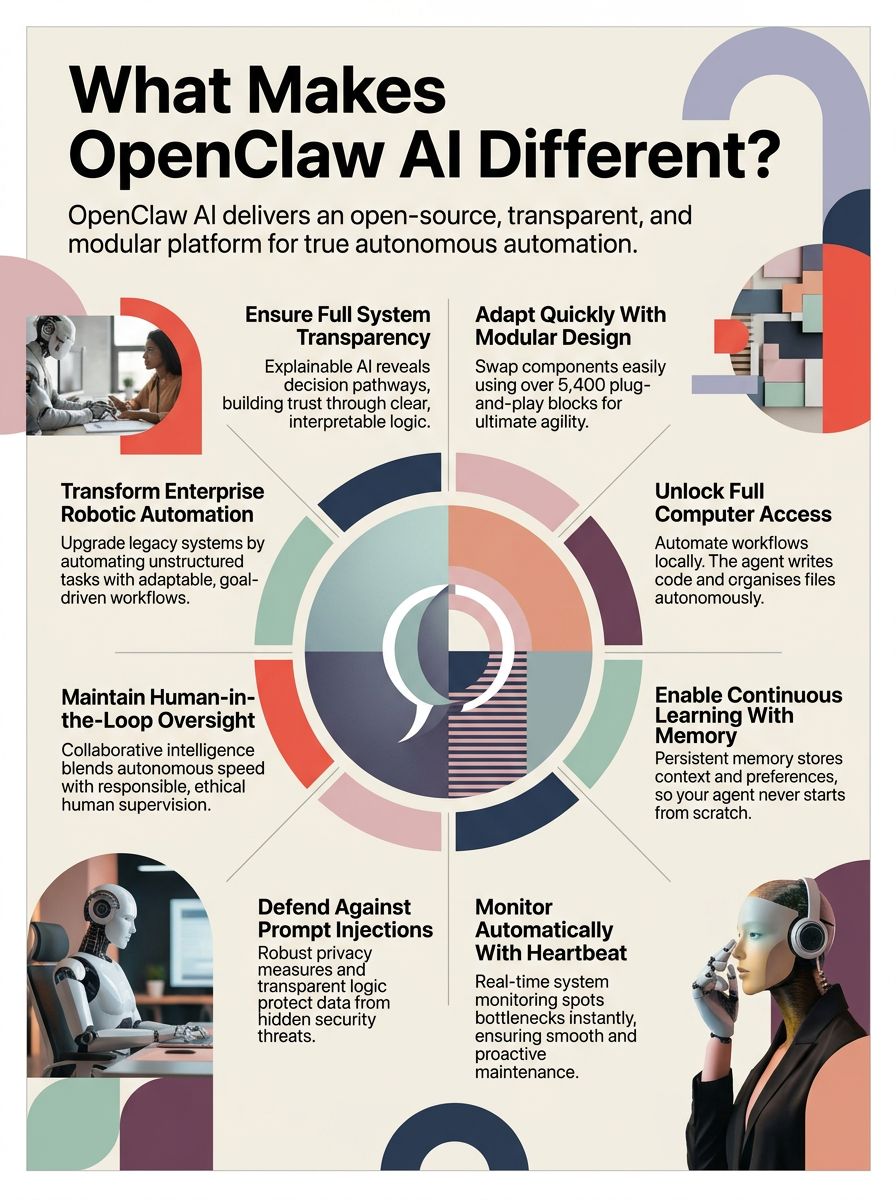
OpenClaw AI sets itself apart from older software agents by giving users more control, transparency, and adaptability. These are qualities missing in many traditional chatbots or generative AI tools.
It connects easily with messaging platforms and programming interfaces like SSH and WebSocket API, making it a powerful option for modern communications and automation needs.
How transparent and interpretable is OpenClaw AI?
OpenClaw AI is highly transparent because it builds on explainable AI principles from its first line of code. Features like LIME (Local Interpretable Model-agnostic Explanations) and SHAP, which uses game theory to assign credit for predictions, allow engineers and users to see exactly why the large language model makes each choice.
Developers can trace decision pathways, open up internal logic on file systems, and check for security risks or prompt injection attempts within seconds. Traditional chatbots keep their thinking hidden, but this platform unmasks those decisions using full computer access and version control.
A March 2026 report from Infosecurity Magazine shows that hiding AI logic behind a black box results in vulnerabilities, whereas adversarial training and transparency can reduce attack success rates from 99% to near zero.
Full transparency builds trust between humans and autonomous systems. Actions stay visible throughout runtime environments as well as cloud backups and servers.
How modular and adaptable is OpenClaw AI compared to traditional tools?
OpenClaw AI is exceptionally adaptable because it relies on a modular system, unlike most traditional tools which often feel locked in. You can easily swap or upgrade different parts such as inference engines, data pre-processors, or integration modules without taking down your entire full stack.
This setup lets organisations stay agile with their AI agent needs on messaging platforms and collaboration tools. A 2025 Gartner report predicts that businesses adopting a composable, modular architecture will outpace their competition by 80% in implementing new features.
| Feature | Traditional Chatbots | OpenClaw AI |
|---|---|---|
| Architecture | Monolithic and rigid | Modular with 5,400+ plug-ins |
| Execution Speed | Standard fixed routines | Up to 80% faster feature deployment |
| Customisation | Limited hardcoded rules | Broad options for IoT devices and smart home controls |
Most conventional AI agents use monolithic layouts where any change slows progress. OpenClaw enables you to define chains of instructions that run either one after another or only under certain conditions, making it a natural fit for enterprise automation.
How does OpenClaw AI handle data and governance differently?
OpenClaw AI handles data differently by prioritising high-quality information with strong provenance over massive, unverified datasets. The platform uses data validation and lineage tracking tools so every dataset's source and history are clear before it touches any autonomous systems or AI bot.
Data integrity forms the basis for trust in each output. A 2026 IBM report reveals that poor data quality costs the average US organisation $12.9 million annually, making OpenClaw's strict validation processes highly valuable.
- API Governance: OpenClaw actively engages with APIs using clear protocols like OAuth 2.0 during tasks like connecting messaging platforms or interacting through command-line tools.
- Unified Governance Framework: It supports safe scalability with fewer hardcoded rules and greater flexibility for advanced agentic AI workflows.
- Cloud Integration: It safely manages multiple host machines, coding environments, or platforms like Amazon and Anthropic without exposing sensitive information.
Key Features of OpenClaw AI
OpenClaw AI connects with both messaging platforms and the internet, making your ai agent more useful than traditional chatbots. It brings features that help create a personal assistant that keeps learning without losing past context.
What does full computer access mean for OpenClaw AI?
Full computer access gives OpenClaw AI the freedom to operate like a true autonomous AI agent. It can write code, change configurations, and execute tasks straight from your local machine using models like Llama 3 or Mistral running on Apple M3 or NVIDIA RTX processors.
With this level of control, it manages applications, organises files, and builds new tools without waiting for prompts from a user. The framework interacts with browsers or messaging platforms and automates workflows just like an expert personal assistant would.
Security is always a major concern with such broad permission levels. Full access does create possible security risks including prompt injection or backdoors, so users should limit permissions and set up strong safeguards. Running locally means data never leaves your device or goes to third-party servers.
Granting full computer access can turn an ordinary ai agent into an unstoppable force but only if you protect the keys.
How does persistent memory enable continuous learning?
OpenClaw AI uses persistent memory to store context, activity logs, and user choices right on the device. This means an AI agent can recall past messages or instructions across messaging platforms without losing track of important details.
Rather than relying on short chats stored in volatile memory, OpenClaw AI uses local vector databases like Pinecone or ChromaDB to securely store and retrieve information. This approach offers several distinct advantages.
- 24/7 Automation: Scheduled workflows keep running because the agent never forgets what needs doing next.
- Speed and Accuracy: By never starting from scratch, OpenClaw AI streamlines complex jobs like enterprise processes or agentic transformation projects.
- Threat Mitigation: Local handling boosts privacy against social engineering threats linked with cloud-based frontier AI models.

What is the Heartbeat feature and how does it support real-time monitoring?
The heartbeat feature acts as a built-in signal that lets the AI agent in OpenClaw run on a steady, predictable schedule. It commonly uses a 10-second or 60-second ping interval using WebSocket or MQTT protocols to check for new tasks and triggers.
This constant monitoring helps AI agents spot issues or bottlenecks quickly, leading to fast troubleshooting and smoother performance. Real-time reports from the Heartbeat System improve how messaging platforms and infrastructure talk to each other.
The system uses this feedback to adjust its models automatically, keeping personal assistants up-to-date without manual updates. IT managers use this heartbeat data for proactive maintenance, keeping their security risks low by tracking changes that could affect competitive advantage in enterprise automation.
Security Advancements in OpenClaw AI
OpenClaw AI sets a new standard for safe digital agents by protecting your data and keeping security risks away.
How does OpenClaw AI achieve defence through transparency?
Transparent systems help security teams spot threats and prevent prompt injection attacks. OWASP's 2025 Top 10 for LLM Applications ranks prompt injection as the number one critical vulnerability, appearing in over 73% of production AI deployments.
OpenClaw AI counters this by using explainable AI tools like SHAP and LIME, so developers can see how predictions are made in real time. This visibility helps people trace the logic of AI agents, quickly finding odd behaviour or attempts at manipulation within autonomous systems.
Clear model outputs let businesses identify vulnerabilities and react fast to any detected risk. Continuous auditing ensures every AI agent acts as a secure personal assistant during enterprise automation tasks using persistent memory technology.
What enhanced data privacy measures does OpenClaw AI use?
OpenClaw AI puts strong data privacy measures in place to limit user access. It follows the NIST AI Risk Management Framework (AI RMF) to grant only minimum rights, helping cut down risks from sensitive personal data.
The system keeps your information hidden even while improving how AI agents work on messaging platforms or with persistent memory.
- Federated Learning: Trains AI models across multiple decentralised devices holding local data samples without exchanging them.
- Differential Privacy: Adds mathematical noise to datasets so individual user data cannot be identified or reverse-engineered.
- Human-in-the-loop: Keeps a human in control for critical tasks to improve safety alongside ConnectWise ScreenConnect integration.
Ethical Frameworks in OpenClaw AI
OpenClaw AI sets new ethical standards in agentic AI and autonomous systems, shaping safer and smarter technology choices.
How does collaborative intelligence promote responsible AI use?
Collaborative intelligence blends advanced AI agents with strong human oversight, making sure each action is monitored and accountable. OpenClaw AI brings people into the loop through messaging platforms, persistent memory, and clear logging of decisions.
PwC's 2025 Responsible AI survey found that companies with strong governance frameworks report higher efficiency and return on investment. Modularity lets various contributors, like AI Ethics Officers and Compliance Analysts, improve the system while conditional task execution keeps workflows flexible but under watchful eyes.
Shared control in OpenClaw encourages responsible delegation, allowing enterprises to spot errors or security risks early. Rapid integration of new safeguards means the framework stays up to date against prompt injection threats or obfuscated activities.
What built-in safeguards prevent misuse of OpenClaw AI?
OpenClaw AI uses strict safeguards to prevent misuse and protect users from hidden vulnerabilities. Advanced bias detection tools, including feature importance analysis and disparate impact checks, spot unfair patterns in AI agent decisions.
A 2026 IBM Cost of a Data Breach Report shows average breach costs reached $4.88 million in the US, making active protection strategies essential for any autonomous system.
| Safeguard Protocol | Primary Function |
|---|---|
| Privacy-Enhancing Technology | Protects sensitive data within autonomous systems and messaging apps. |
| Explainable AI (XAI) | Keeps decision-making clear so personal assistants act predictably. |
| Real-Time Auditing | Spots prompt injection or other threats rapidly before execution. |
A human-in-the-loop approach supports the responsible use of persistent memory and agentic AI actions. OpenClaw combines transparency, privacy controls, regular oversight, and ongoing risk management to stop abuse before it happens.
Real-World Applications of OpenClaw AI
OpenClaw AI powers agentic automation, personal assistants, and advanced AI agents across messaging platforms to transform daily tasks and business processes.
How does OpenClaw AI enable enterprise automation and agentic transformation?
AI agents in OpenClaw work all day to handle browsers, files, and applications without waiting for a prompt. These persistent AI agents remember user preferences and task history using long-term memory to automate recurring tasks across enterprise tools like Salesforce or SAP.
Early adopters in customer service achieve 20 to 40% efficiency gains through automated case routing, according to 2025 Salesforce data. Enterprises benefit from agentic AI that creates new tools to solve unique problems on demand.
- Proactive Automation: Executes scheduled monitoring and recurring workflows effortlessly.
- Continuous Learning: Shapes smarter responses as OpenClaw adapts to changing data and security needs.
- Scale and Efficiency: Brings true personalisation at scale while reducing reliance on static scripts.
How is OpenClaw AI integrated with robotic process automation (RPA)?
OpenClaw AI gives robotic process automation a new level of flexibility by moving beyond rule-driven tasks to bring goal-driven automation to the table. Over 80% of enterprise data is unstructured, making agentic AI the perfect partner for traditional RPA tools like Automation Anywhere.
OpenClaw can process unstructured data like emails or scanned forms, letting RPA tackle situations that used to need human input. The system connects with messaging platforms, personal assistants, and even legacy software using its full computer access.
The integration creates a hybrid setup where modular OpenClaw AI adapts on the fly while RPA handles structured micro-tasks in finance, healthcare, or logistics. By orchestrating end-to-end workflows, OpenClaw allows autonomous systems to self-optimise over time through persistent memory.
Conclusion
OpenClaw AI stands apart by bringing full transparency, modular tools, and ethical frameworks to the table. Its persistent memory and real-time monitoring give AI agents personalised support far beyond traditional chatbots or assistants.
With continuous operation through cloud servers like Hostinger, users enjoy automated workflows and seamless integration with messaging platforms. Security risks are tackled head-on thanks to open code and clear data governance, while collaboration drives fast innovation within autonomous systems too.
This makes OpenClaw more than just another productivity experiment. It sets a new pace for agentic AI in modern business environments.
For an in-depth understanding of how OpenClaw AI integrates with autonomous AI workflows, please visit Autonomous AI Workflows Explained: Where OpenClaw Fits.
FAQs
1. How does OpenClaw AI use persistent memory compared to traditional chatbots?
OpenClaw AI uses local file storage to maintain persistent memory across your conversations, meaning it retains context continuously instead of resetting like traditional chatbots. By saving this data directly on your US-based machine, it functions as a highly capable personal assistant that seamlessly recalls previous instructions.
2. What makes OpenClaw AI's agentic approach unique in messaging platforms?
Unlike standard bots, OpenClaw operates as an open-source agentic AI that runs locally and uses community-built skills to execute real-world tasks autonomously through your favourite messaging platforms.
3. Are there security risks with autonomous ai like OpenClaw?
Yes, because autonomous ai tools like OpenClaw have direct access to your local files, they introduce severe security risks such as indirect prompt injection. A March 2026 report by Lakera AI revealed that attackers can embed hidden instructions in external documents that the ai agent processes, tricking these autonomous systems into executing malicious commands.
4. In what ways does OpenClaw improve personalisation for users?
OpenClaw enhances personalisation by acting as a proactive personal assistant that learns from your specific behaviours and daily routines over time. By keeping all your context securely on your own computer rather than a remote server, ai agents can customise their background tasks to fit your exact US workflow needs.
References
- https://buildwithcham.medium.com/openclaw-explained-fed1c9d6b23f
- https://www.researchgate.net/publication/400788567_OpenCLAW-P2P_A_Decentralized_Framework_for_Collective_AI_Intelligence_Towards_Artificial_General_Intelligence (2026-02-15)
- https://blog.axway.com/learning-center/digital-strategy/artificial-intelligence/openclaw-moltbook-ai-governance
- https://www.turingcollege.com/blog/openclaw (2026-01-30)
- https://www.superlinear.academy/c/share-your-insights-en/learning-openclaw-s-heartbeat-system-design-giving-ai-agents-initiative
- https://milvus.io/ai-quick-reference/what-is-the-openclawmoltbotclawdbot-heartbeat-feature
- https://www.sangfor.com/blog/tech/openclaw-ai-agent-2026-explained
- https://www.pcpd.org.hk/english/news_events/media_statements/press_20260316.html
- https://openclawn.com/openclaw-ai-risk-mitigation/ (2026-02-14)
- https://www.westmonroe.com/insights/openclaw-ai
- https://help.apiyi.com/en/openclaw-vs-rpa-comparison-guide-en.html
- https://www.mindbees.com/blog/openclaw-use-cases-ai-productivity-2026/